
A short-term rental asks something different of photography than a traditional home listing. The guest is not deciding whether the property could become theirs over the next decade. They are trying to understand, often within a matter of seconds, what it will feel like to arrive with a suitcase, close the door behind them, and settle into an unfamiliar space for a few nights.
At 394 Piper Blvd, the story is deliberately compact. A private entry leads into a sleeping space organized around a large bed and built-in shelving. A kitchenette occupies one side of the room, close enough to feel convenient without visually overwhelming the sleeping area. Multiple windows bring daylight into an otherwise restrained gray palette, while a private bathroom completes the suite.
There are no grand gestures to photograph. The appeal of the space depends on something more practical: whether each part of the room feels considered, understandable, and easy to use.
For this project, the photography followed the same sequence a guest might experience. Enter. Look around. Understand where everything is. Begin to imagine the stay.
The Experience Begins Before the Bedroom
The first photograph does not open with the bed.
Instead, the camera pauses in the narrow entry, where pale gray walls, two doors, and a simple floor mat establish a small transitional space before the main room. It is not the most decorative part of the rental, but it answers an important question almost immediately: How do I arrive?
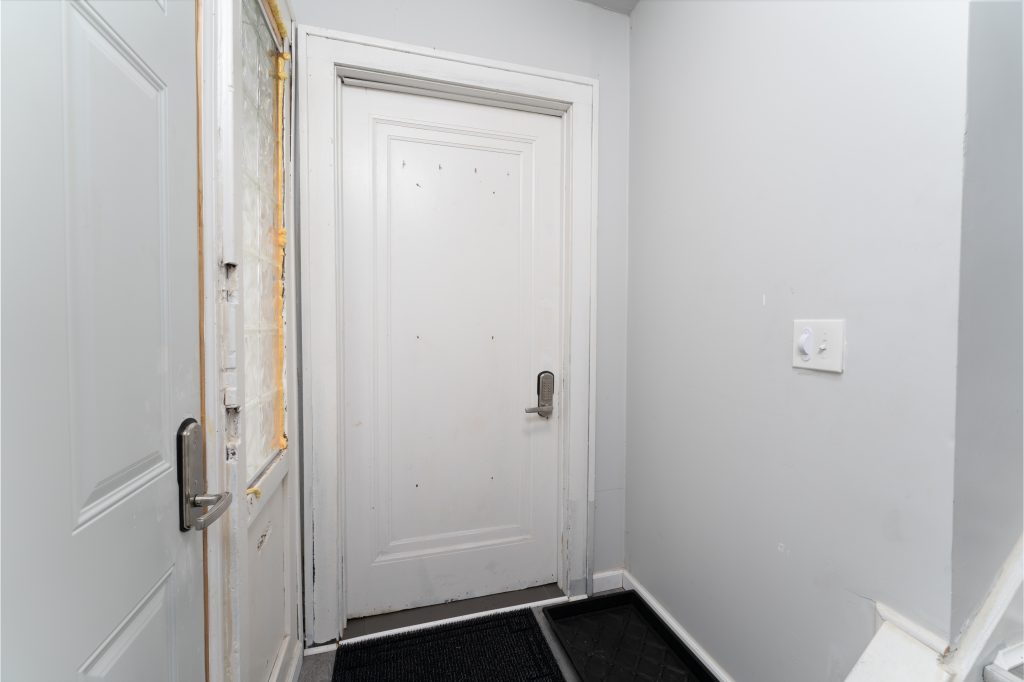
For short-term rental photography, these practical transitions are easy to omit. A gallery may move directly from an exterior image to a beautifully composed bedroom, leaving the guest to mentally fill in everything between the front door and the bed. Yet arrival is part of the experience, particularly in a rental where a separate entrance or self-contained suite may influence how private the stay feels.
Here, the entry is shown plainly. The coded door hardware is visible. The walls are close enough that the scale remains honest. Another doorway appears at the edge of the frame, suggesting the small sequence of spaces beyond.
The photograph is not there to romanticize the vestibule. It establishes orientation before the gallery moves into the room guests will actually inhabit.
The Bed Is the Visual Center of the Stay
Inside, the bed immediately becomes the center of the composition.
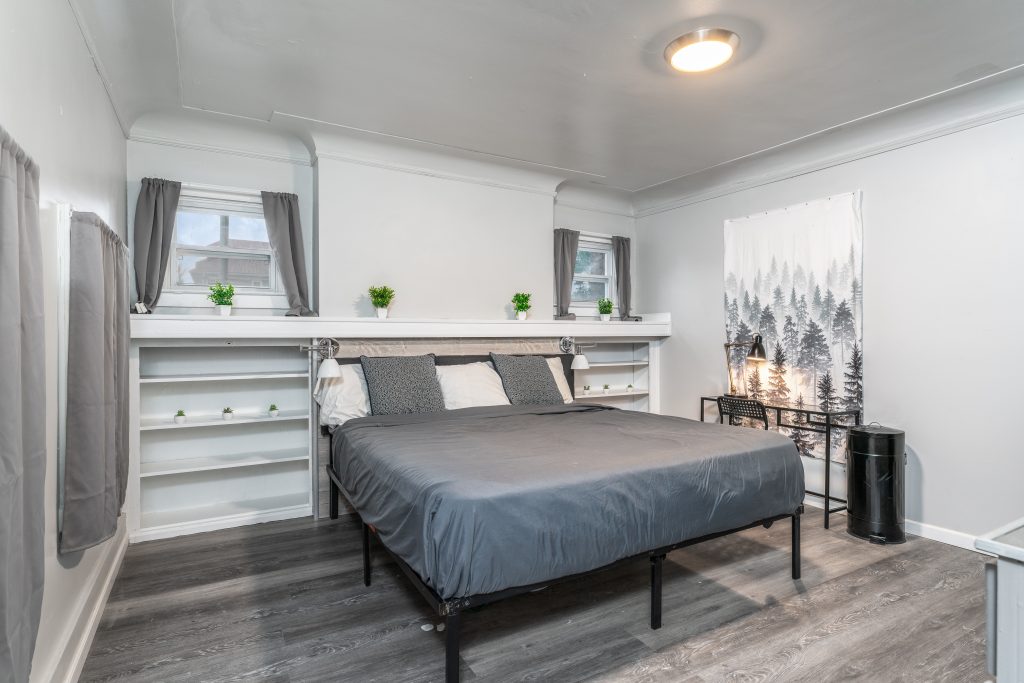
That hierarchy matters. In a residential listing, a bedroom may be one room among many; in a compact short-term rental, the sleeping area is often the principal space. It needs to feel comfortable enough to hold attention while still allowing the viewer to understand what exists around it.
At Piper Boulevard, the bed sits against a wall of built-in shelving, framed by two small windows above. The shelves extend outward on either side, creating a broad horizontal line behind the bed and giving the wall more architectural presence than a conventional headboard might. Small plants occupy the ledges sparingly, adding scale and softness without turning the shelves into decorative clutter.
The first bedroom composition is nearly frontal. From this position, the built-ins, windows, bed, and writing desk can all be read together. The gray bedding echoes the cooler tones of the walls and floor, while the black metal bed frame provides a sharper outline against the pale interior.
There is a restraint to the palette that works particularly well in photographs. Nothing is fighting to become the dominant color. The room’s identity instead comes from proportion, repetition, and the unusually wide built-in feature wall behind the bed.
For an Airbnb, that first interior image needs to answer an emotional question as quickly as a practical one: Would I be comfortable here?
The photograph lets the bed answer first.
Built-In Storage Gives the Room Its Architecture
The shelving deserves more attention because it changes the way the room is perceived.
Without it, the sleeping area might read as a relatively simple rectangular bedroom. The built-ins introduce depth along one wall, wrapping the bed in a composition of ledges and horizontal openings. Even mostly empty, the shelving gives the room structure.
This is where short-term rental photography can benefit from the same kind of observation used in architectural interiors. The goal is not simply to document that shelves exist. It is to understand what they are doing visually.
They frame the bed.
They emphasize the width of the wall.
They create a place for small personal objects without requiring a large piece of furniture.
And because the two windows sit directly above, the entire arrangement feels built around the architecture rather than placed randomly within it.
The photography keeps those relationships visible. A tighter photograph of the bed might have produced a more conventional hospitality image, but it would have lost the built-ins and reduced the room to bedding and pillows. By stepping back, the frame shows why this particular sleeping space looks different from another gray bedroom on a booking platform.
The Kitchenette Has to Read as Useful
Turn away from the bed and the room reveals its second function.
A compact kitchenette stretches along one wall, with gray cabinetry, a stainless sink, microwave, coffee maker, toaster, knife block, and refrigerator arranged in a single line. A visible exhaust duct above the microwave introduces a utilitarian note that the photography does not attempt to conceal.
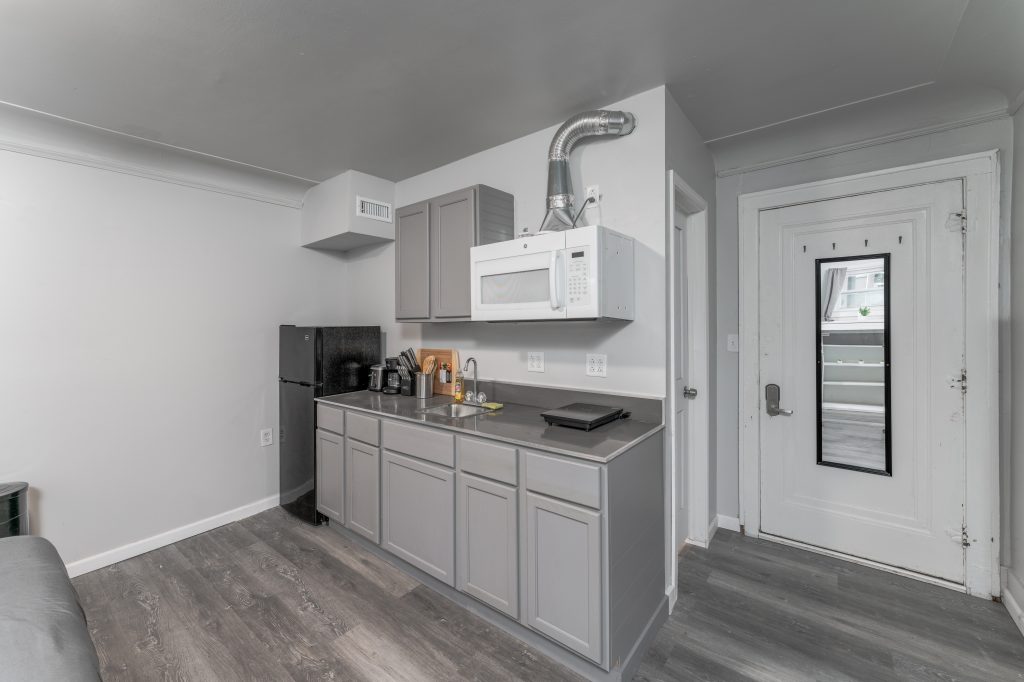
In a short-term rental, this is exactly the kind of space that needs clarity.
A guest may be wondering whether there is somewhere to make coffee in the morning, store leftovers, prepare a simple meal, or keep drinks cold. Those questions are answered through objects and layout. The refrigerator establishes food storage. The sink and counter create a work surface. Small appliances indicate the kinds of everyday routines the kitchenette can support.
The first view approaches the kitchenette more directly, giving the cabinetry and appliances enough prominence that they can be understood individually. The entrance remains visible beside it, quietly reconnecting the functional wall to the guest’s route into the room.
From the opposite angle, the composition becomes more revealing. The kitchenette occupies one side of the frame while the bed extends into the foreground, showing just how closely the two functions coexist.
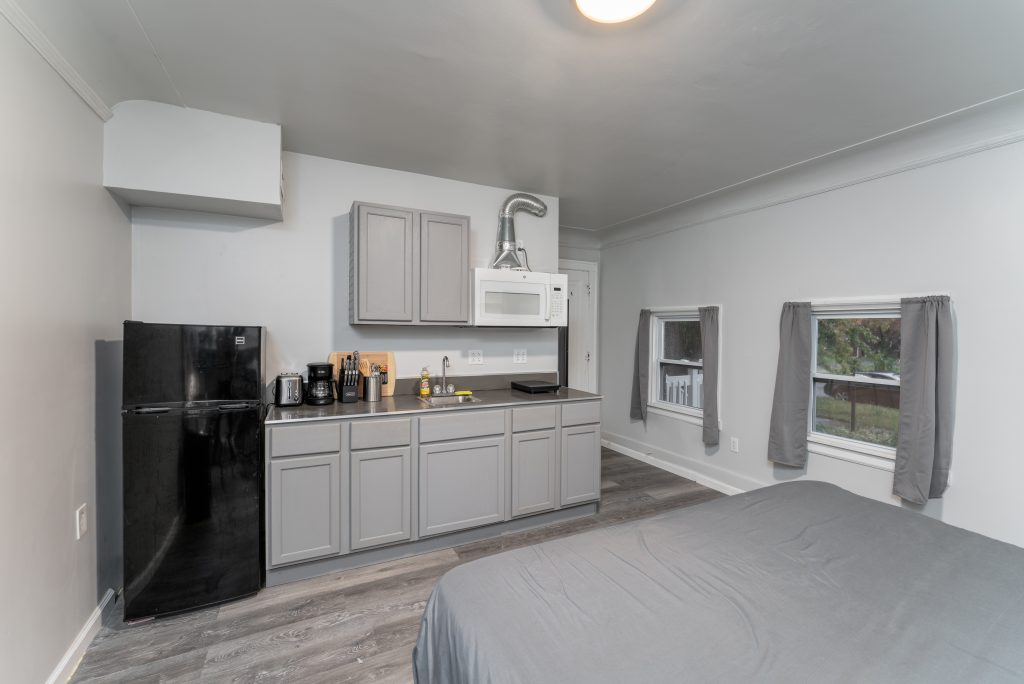
That could easily be a disadvantage if photographed carelessly. A very wide lens might stretch the room until the kitchenette and bed appear unrealistically far apart. A tight crop might hide their relationship entirely.
The better approach is to let the compactness remain visible.
This is a studio-like guest space. The bed and kitchenette share a room. The photography should make that arrangement attractive and understandable without asking perspective to invent separation that does not exist.
One Room Has to Explain Several Routines
The reverse bedroom views are particularly important because they reveal how much the room is being asked to do.
From one angle, the bed dominates. From another, the kitchenette becomes more prominent. A third view places the windows between the two, allowing the room’s length and circulation to emerge.
Three small windows line the exterior wall, their gray curtains repeating the neutral palette used throughout the suite. Natural light enters at multiple points rather than through one large opening, creating a softer and more distributed brightness. The bed occupies one end of the room while the countertop begins at the other, leaving a clear path between them.
For the guest, these are simple relationships. Wake up. Make coffee. Set something on the counter. Sit at the desk. Return to the bed.
The photography needs to make those routines conceivable.
This is why photographing a short-term rental is not simply a matter of making a room look polished. A booking gallery is, in many ways, an instructional sequence. Without using diagrams or explanatory text, the photographs show where the guest will sleep, where they can prepare food, how much open floor remains, and what other furnishings are available.
At Piper Boulevard, one room carries several functions. The visual narrative works because the camera changes position enough to let each function come forward without pretending the others disappear.
Windows Bring Rhythm to a Restrained Interior
The room’s color palette is notably quiet: white, gray, charcoal, and muted wood tones dominate almost every surface. In a space without strong color contrast, the windows become important visual punctuation.
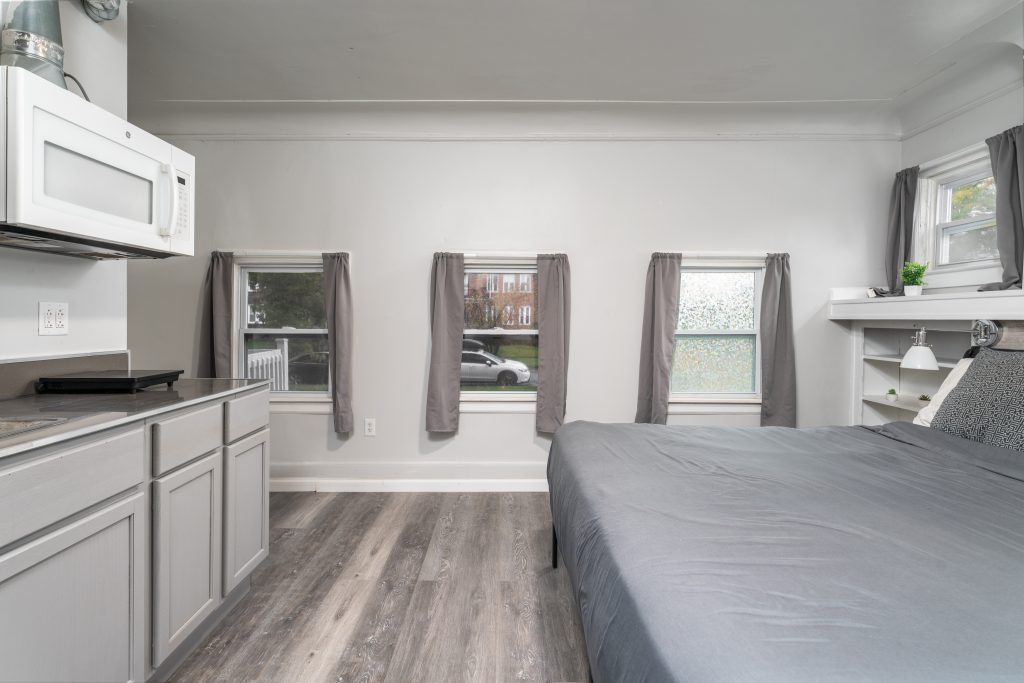
Seen from the kitchenette side, three windows repeat across the wall beside the bed. Their small scale and regular placement create a rhythm that breaks up what would otherwise be a broad expanse of pale wall. Curtains frame each opening individually, reinforcing the repetition.
From the bed-facing angle, two additional windows sit above the built-in shelving. Together, these openings allow light to enter the room from more than one direction.
The photography preserves that daylight while maintaining the visibility of interior surfaces. The windows are bright, but they are not reduced to blank white rectangles; exterior forms remain perceptible in several views. At the same time, the bed, cabinetry, and gray flooring retain their tonal differences.
For a short-term rental, light is part of the promise of the room. Guests are unlikely to study exposure technique, but they will notice whether a space appears dark, flat, or difficult to understand.
The aim is not to make the suite glow unnaturally. It is to show that, despite its restrained palette and compact arrangement, the room receives enough light to feel open and usable.
The Bathroom Completes the Suite
The bathroom is the final piece of the guest experience, and its photograph is intentionally straightforward.
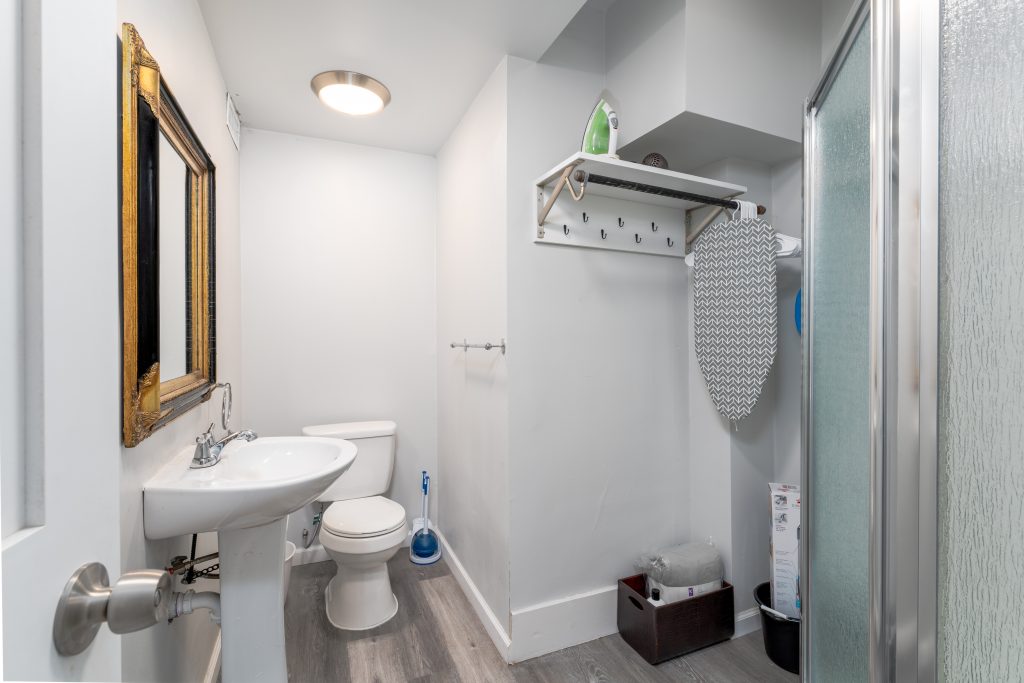
A pedestal sink and toilet occupy one side of the narrow room, while a glass-enclosed shower runs along the opposite wall. An open utility area holds an ironing board and shelf, revealing that the bathroom also absorbs some of the practical storage needs of the rental.
This is not a spa-like bathroom, and the photography does not attempt to suggest otherwise.
Instead, the frame shows the full relationship between the fixtures. The camera remains near the doorway, where the sink, toilet, shower, and utility area can all be seen in one composition. The narrow proportions remain visible, but so does the fact that each principal feature has its own place.
For hospitality photography, this kind of honesty is particularly important. A guest who books a room based on dramatically stretched photographs will discover the true dimensions almost immediately upon arrival. The goal of effective short-term rental media is not to postpone that understanding.
It is to make the actual space appealing enough that accuracy becomes part of the confidence to book.
Photographing for the Guest Who Has Never Been There
The most important person in a short-term rental gallery is someone standing nowhere near the property.
They may be scrolling from another city. They may be comparing several accommodations in neighboring browser tabs. They do not know the floor plan, the route through the entrance, or whether the kitchenette and bed occupy separate rooms. Every spatial relationship that feels obvious after walking through the suite has to be rebuilt through photographs.
That was the approach at 394 Piper Blvd.
The entry establishes arrival. The frontal bedroom view introduces the bed and built-in shelving. Reverse angles reveal the kitchenette and show how the room’s functions coexist. The windows bring rhythm and daylight into a restrained palette, while the final bathroom image completes the practical sequence of the stay.
Nothing in the gallery needs to make the rental appear larger or more elaborate than it is. The space works because its purpose is clear.
For short-term rental photography, that clarity is part of the hospitality. Before the guest has entered a code, opened the door, or placed a suitcase on the floor, the images have already begun to show them how the space lives.
And for a property designed around a short stay, that may be the most important story the photographs can tell.
