
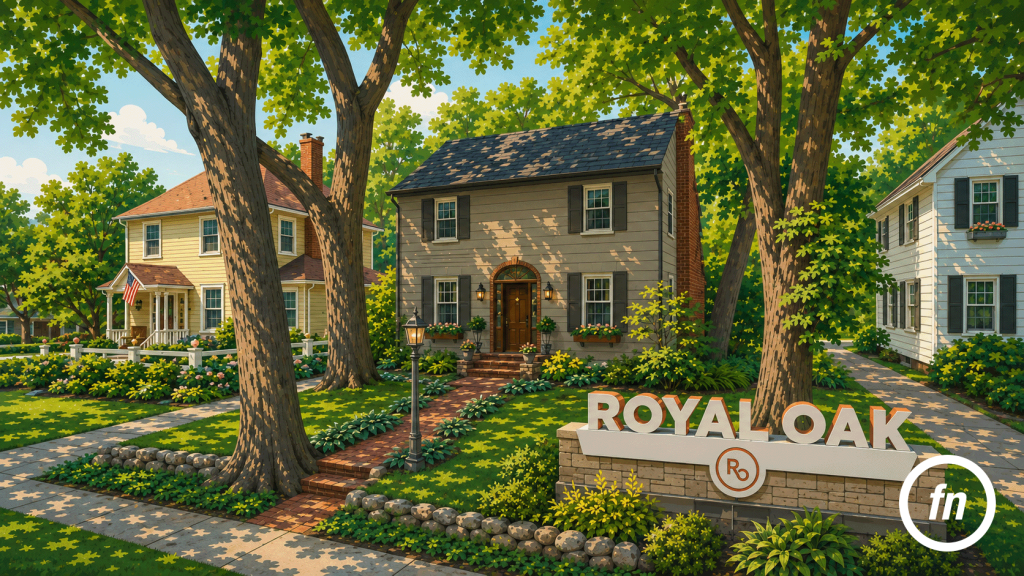
A house is rarely photographed alone in Royal Oak. Even when the architecture occupies the center of the frame, there is often something else shaping the picture: the dark trunk of a maple at the curb, a canopy extending over the roofline, or a long band of afternoon shade falling across the lawn. In summer, leaves can turn an ordinary residential street into a green corridor. By October, the same block may be almost unrecognizable, its houses appearing through layers of amber, rust, and yellow.
Royal Oak has long embraced the identity of the “City of Trees,” and the name feels particularly fitting from the sidewalk. The city’s residential landscape is defined not only by houses, but by the relationship between houses and the mature vegetation around them. Trees soften rooflines, frame porches, filter sunlight, and create a sense of continuity from one property to the next. The effect is often so familiar that it becomes easy to overlook.
For real estate photography, that would be a mistake.
A tree is not simply an obstruction between the camera and the house. In the right composition, it can establish scale, create depth, soften a modest façade, and reveal something about the character of the street that architecture alone cannot. The challenge is knowing when to move around it, when to photograph beneath it, and when to let it remain exactly where it is.
Royal Oak’s Tree-Lined Identity Is More Than a Backdrop
The relationship between Royal Oak and its trees is woven into the city’s identity. The community is widely known as the “City of Trees,” a nickname associated with the extensive planting that helped shape its urban landscape over generations. Today, mature trees remain one of the most visible elements of many residential streets, occupying the space between sidewalk and curb, spreading across front lawns, and joining overhead to create the impression of a continuous canopy.
From a photographic perspective, this greenery does more than make a neighborhood attractive. It changes how the architecture is perceived. A small house beneath a mature canopy can feel settled into its surroundings in a way that a newly built landscape cannot immediately reproduce. The trunk of a large street tree introduces scale; its branches create a natural frame; the filtered light beneath its leaves can soften brick, siding, and landscaping that might otherwise appear flat in direct sun.
This is particularly noticeable on Royal Oak’s older residential blocks, where the relationship between the house, sidewalk, boulevard, and street tree has had decades to mature. The trees do not merely sit in front of the architecture. They participate in the streetscape.
The best Royal Oak listing photography should understand that relationship before deciding what belongs inside the frame.
A Canopy Can Make a Small House Feel Grand
Not every house needs a dramatic roofline or monumental entrance to have presence from the street. Sometimes that presence comes from what surrounds it.
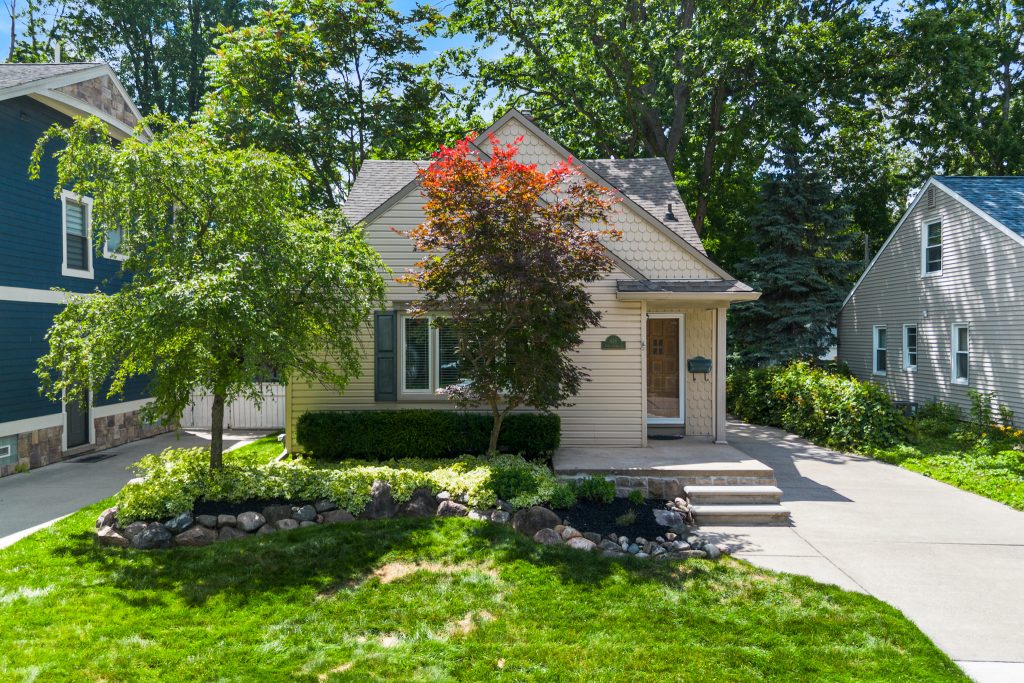
Consider a modest bungalow or compact midcentury house beneath the spread of a mature tree. The architecture may occupy only a portion of the frame, yet the branches above can create a much larger visual envelope around it. The eye moves from the trunk to the canopy, down toward the roofline, and finally to the porch or front door. What might have appeared small in isolation begins to feel established and composed.
This is one reason aggressively cropping trees from an exterior photograph can sometimes diminish the house rather than improve it. The instinct is understandable: buyers need a clear view of the property, and branches can obscure windows, rooflines, or architectural details. But removing every trace of the surrounding canopy can also remove the scale and atmosphere that made the scene appealing in the first place.
A stronger approach is often to work with layers. A trunk can occupy the edge of the frame rather than the center. Overhanging branches can create a natural border across the top of the image. The house can remain clearly visible while the tree provides foreground depth, allowing the photograph to feel less like a record of a façade and more like a view of a home within a neighborhood.
The difference is subtle. The tree should not hide the property, but neither does it always need to disappear.
The Street Tree Belongs in the Frame
Real estate photography has a long list of things it routinely tries to remove from an exterior composition: parked cars, trash bins, utility clutter, temporary signs, and anything else that distracts from the house. A street tree can initially seem like another obstacle, particularly when its trunk stands directly between the most convenient camera position and the front elevation.
Yet a mature tree is fundamentally different from clutter. It is a permanent part of the streetscape, and often one of its most valuable visual elements.
The question is not whether the tree should be included, but how.
A few steps to the left may allow the trunk to frame the house rather than divide it. Moving farther back can create enough space for the canopy to become visible as a whole. Photographing from beneath the branches can produce layers of foreground, architecture, and sky, while a view down the block may reveal how one tree connects visually with the next.
These compositions can be especially effective when the goal is to communicate neighborhood character. A tightly framed exterior tells the buyer what the house looks like. A wider image that includes the sidewalk, street trees, neighboring lawns, and some depth down the block begins to explain what it might feel like to arrive there.
In that sense, the tree becomes part of the façade—not literally, but visually. It influences how the house is first encountered and how it is remembered.
Midday Light Isn’t Always the Enemy
Real estate photographers are taught, with good reason, to pay close attention to the position of the sun. A façade photographed at the wrong time can fall into deep shadow, while harsh midday light can create bright highlights and hard transitions that are difficult to balance.
A mature canopy complicates that equation, but it can also make it more interesting.
Beneath trees, midday light rarely arrives as one uninterrupted sheet of brightness. Leaves break it apart. Patches of sun move across brick, siding, lawn, and pavement, while the canopy itself creates cooler areas of shade. The result can be visually rich, particularly when the house has materials that respond well to directional light.
Brick may gain texture as small shadows settle into mortar joints. A porch can feel deeper when its shaded interior is contrasted against a sunlit lawn. Leaves in the foreground may catch the light while the house remains slightly quieter behind them.
The challenge is exposure. If the brightest patches are allowed to dominate, the photograph can feel harsh and fragmented. If every shadow is lifted until it matches the highlights, the scene can lose the depth that made the light interesting in the first place.
The objective should not always be perfect uniformity. On a tree-lined street, variation in light is part of the atmosphere.
There are still times when returning later in the day is the better decision, particularly when a dense canopy leaves the entire front elevation in heavy shadow. But midday should not automatically be treated as unusable. Sometimes the tree that complicates the light is also what gives the photograph its character.
Shade Can Reveal How a Home Feels in Summer
Seasonal photography is often discussed in terms of color, but temperature has a visual language too.
A photograph cannot tell a buyer exactly how cool a shaded front porch feels in July, yet it can suggest the experience. A deep canopy above the sidewalk, dappled light across the lawn, and a porch resting in shade all create a visual sense of shelter that a completely exposed façade does not.
This is where curb appeal becomes more than landscaping.
The relationship between the house and its trees can suggest how the property changes throughout the day. Morning light may reach one side of the façade before the canopy fills in overhead. By afternoon, the lawn may be patterned with shadow. A front porch beneath both its own roof and the branches above can feel especially protected from the brightness of summer.
For an editorial sequence, these observations can be more evocative than another perfectly centered exterior. A photograph made from the sidewalk beneath the canopy, for example, can place the viewer within the experience rather than simply showing the property from a distance.
The house remains important, but the photograph begins to communicate atmosphere.
Fall Changes the Architecture
Few seasons alter the appearance of a house as dramatically as autumn.
A red brick façade that feels warm against summer greenery may become almost monochromatic beside orange leaves. Pale siding can stand out sharply against a canopy of deep red and gold. A dark roof may recede beneath bare branches later in the season, revealing a silhouette that was partially hidden only weeks before.
This is one reason seasonal photographs can be especially valuable for homes in established neighborhoods. The architecture itself has not changed, but its visual context has.
Fall color can be spectacular, which also makes it easy to overdo. A photograph dominated entirely by foliage may become an image of a tree with a house somewhere behind it. Heavy editing can push already vivid colors into something that no longer resembles the property as it appeared in person.
Restraint matters here too.
The strongest autumn exterior often allows the seasonal color to frame the architecture rather than overwhelm it. A branch entering from the edge of the image, a carpet of leaves along the curb, or a canopy visible above the roofline can establish the season while keeping the house legible.
The purpose is not to make every listing look like October forever. It is to show how the property belongs to a landscape that changes.
Bare Branches Tell a Different Story
The disappearance of leaves is often treated as a disadvantage in real estate photography. Lawns lose color, trees become skeletal, and the lushness of summer gives way to a more exposed landscape.
Yet winter and early spring can reveal things the canopy hides.
Rooflines become clearer. Dormers emerge. Chimneys that disappeared into summer foliage become part of the silhouette again. The relationship between neighboring houses may be easier to understand, and the branching structure of a mature tree can become an architectural element of its own.
A bare tree can frame a house with extraordinary delicacy. Its branches create fine lines against the sky, often echoing the geometry of roof pitches, window divisions, and porch details below.
The photograph becomes less about abundance and more about structure.
For a year-round portfolio, these seasonal differences are useful reminders that there is no single correct way to photograph a tree-lined property. The same house may ask for a completely different composition in July than it does in February.
The Canopy Helps Explain the Street
A single tree can shape a façade. A row of them can shape an entire neighborhood.
When mature street trees begin to overlap above the roadway, the effect is larger than any individual property. The block develops a ceiling. Light becomes filtered. Houses appear through trunks and branches rather than standing completely exposed to the street.
This is one of the reasons a block-level photograph can be valuable in a Royal Oak listing. The image may not show the property as prominently as the primary exterior, but it can reveal the setting that surrounds it every day.
The most effective streetscape photographs tend to be simple. A view down the sidewalk can emphasize the repetition of trees and front lawns. A position near an intersection can show how the canopy continues onto the next block. From the street, a longer view may reveal branches joining overhead while houses remain visible beneath them.
These images should not replace the property photography. They provide context for it.
A buyer can see the kitchen in another frame. The streetscape image answers a different question: What does it feel like to be here?
Drone Photography Should Respect the Canopy
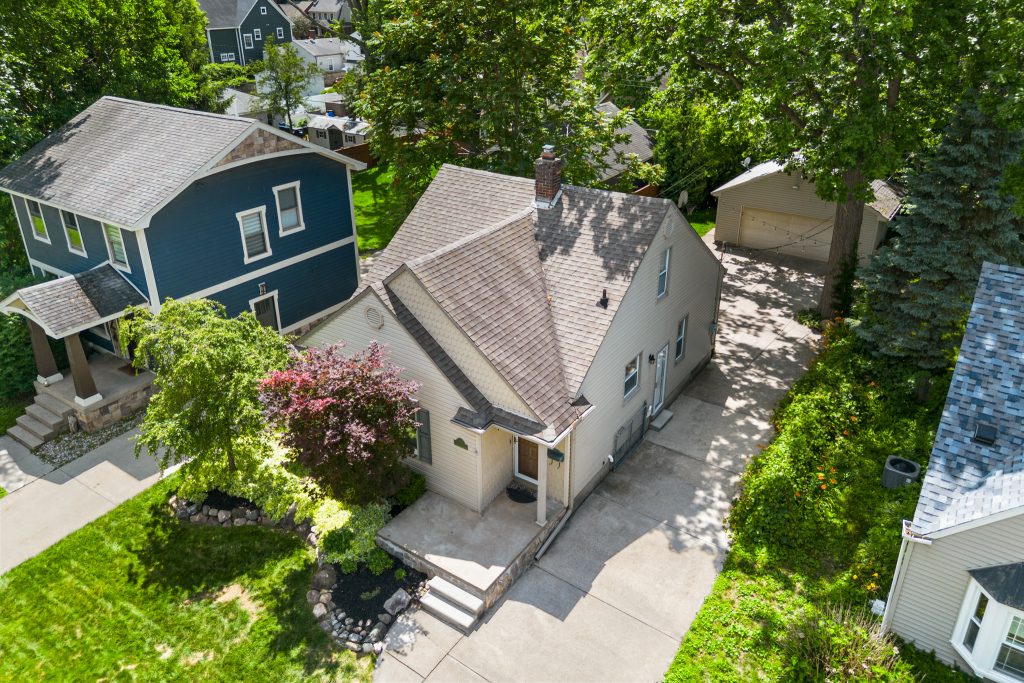
From the ground, a mature tree can seem enormous. From above, it becomes part of something larger.
Drone photography can reveal the extent to which tree cover shapes a residential neighborhood, showing individual crowns spreading across lots and, in the leafiest areas, partially obscuring houses beneath them. The perspective can be striking, but it also presents a practical challenge: the very canopy that makes the neighborhood beautiful can hide the property being photographed.
The solution is not always to fly higher.
At excessive altitude, the listing can become a small roof among many, and the image loses its connection to the property. A more useful aerial photograph often works at an oblique angle, allowing the viewer to see the front or rear elevation while still understanding the surrounding canopy. The house remains identifiable, but the trees explain its setting.
Season and time of day matter here as well. Summer foliage can make the neighborhood appear lush but obscure lot boundaries. Bare branches can reveal the relationship between house, garage, yard, and neighboring properties more clearly. Low-angle light can give the crowns of trees dimension, while flat overhead light may turn the canopy into a nearly continuous surface of green.
Aerial photography should not treat trees as something to rise above and leave behind. In a city that identifies so closely with them, the canopy is part of what the aerial view is there to show.
Trees Can Hide a House, and That Matters Too
Not every mature tree improves every photograph.
Some properties are genuinely difficult to see from the street. Dense branches may cover the front elevation. An overgrown tree may obscure a window or entrance. Multiple trunks can divide the façade in ways that no camera position completely solves.
The photographer’s role is not to pretend those conditions do not exist.
Instead, the gallery can use several views to build a more complete understanding of the property. One wider image may show the house within its heavily wooded setting. A second, closer composition can clarify the architecture. An angled view may reveal details hidden from the straight-on perspective.
This is more effective than forcing a single photograph to do everything.
The primary image should still present the house clearly, but clarity does not require erasing the landscape. When a property is defined in part by mature trees, showing that relationship honestly can be more compelling than finding one narrow angle from which the trees appear not to exist.
The Best Exterior Photograph Knows What to Keep
Curb appeal is often described as though it belongs entirely to the house: paint color, landscaping, porch design, front door, roofline. In established neighborhoods, however, some of the most powerful elements may sit outside the property line.
The street tree belongs to the city, yet its canopy may shade the front lawn.
Branches from a neighboring property may frame the roof.
A row of mature trees may create the setting that makes the entire block memorable.
Good exterior photography is therefore an exercise in editing rather than removal. The photographer decides which elements distract from the house and which ones help explain it. A utility pole may need to be minimized. A trash bin can be moved. A mature tree, on the other hand, may be the reason the composition works.
That judgment is especially important in Royal Oak, where the city’s tree-lined identity is not merely a slogan but a visible part of many residential streets.
The Trees Are Part of the Facade
A house does not end at its exterior walls.
Visually, it extends into the landscape around it: the front walk that leads toward the sidewalk, the lawn that establishes its setback, and the trees that filter the light before it reaches the roof, windows, and porch.
In Royal Oak, those trees can be as important to the first impression of a property as the architecture itself. They make small houses feel settled. They give streets a sense of continuity. They change the quality of light from one hour to the next and transform the same façade from season to season.
The best Royal Oak listing photography does not automatically crop them away or treat them as obstacles to work around. It looks at what the tree is doing for the house before deciding where the camera should stand.
Sometimes the right choice is to move until the façade is completely clear. Sometimes it is to let a branch enter the frame, to photograph beneath the canopy, or to pull back far enough that the tree and house can be understood together.
Because in the “City of Trees,” the landscape is not simply behind the story of the home.
It is already part of the picture.
