
Detroit is a city where architecture often reveals itself slowly.
A house may first catch the eye because of its size or symmetry, but the details tend to linger: the irregular color of century-old brick, the depth of a limestone surround, the soft distortion of light through leaded glass, or the way a staircase turns beneath a plaster arch. In neighborhoods such as Boston-Edison and Russell Woods, these details are not decorative footnotes. They are part of the house’s identity.
That distinction matters when a historic Detroit home comes to market.
Real estate photography is often built around immediate impact. Rooms are made to feel larger, exteriors are polished into perfect hero images, and every surface is expected to look new. But historic homes ask for a different kind of attention. Their appeal is often found in proportion, craftsmanship, material, and evidence of time. Photographing them well means resisting the urge to make every property look like the same version of “luxury.”
In Detroit’s historic districts, the more interesting story is usually already there.
Detroit’s Historic Homes Do Not Speak a Single Architectural Language
There is no one visual shorthand for a historic Detroit home. The city’s residential neighborhoods developed across different periods, for different buyers, and at different scales. Even within a single district, architectural styles can change from one property to the next.
Boston-Edison and Russell Woods make that point especially well.
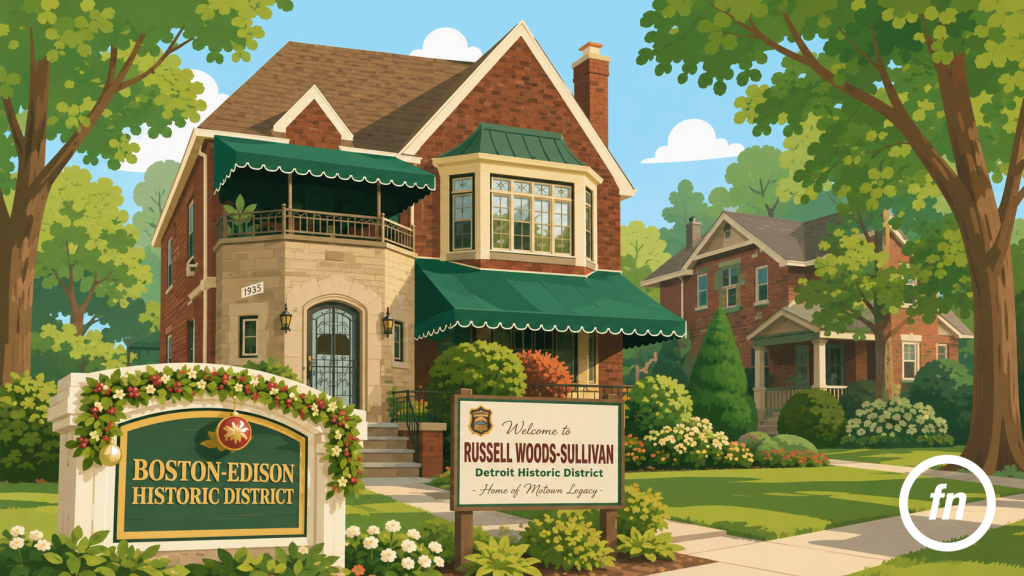
Both are known for early-20th-century residential architecture and remarkable craftsmanship, but they create very different experiences from the street. Boston-Edison is defined in part by scale: broad streets, generous setbacks, large houses, and an architectural vocabulary that can shift dramatically from one lot to the next. Russell Woods is more intimate. Its historic character comes from the collective rhythm of more than a thousand homes, where Tudor Revival, Colonial Revival, Craftsman, Moderne, and other influences appear within a neighborhood built largely around the needs of middle-class Detroit families.
The difference is important because the same photographic approach should not simply be applied to both.
A Boston-Edison house may call for an image that allows the architecture to command the frame. A Russell Woods home may become more meaningful when the photograph also acknowledges the neighboring porch, the mature tree canopy, or the repetition of rooflines along the block.
Historic architecture is not a category to photograph. It is something to read.
Boston-Edison Begins With the Approach
There is a particular experience to arriving at a house in Boston-Edison. The building is often visible before its details are.
The neighborhood was shaped by wide streets, landscaped grounds, and substantial setbacks. Many of its homes were built between 1905 and 1925, and its architecture spans a broad range of styles, including English Revival, Colonial Revival, Italian Renaissance, Prairie, and others. Brick, stone, and stucco appear throughout the district, joined by details such as leaded-glass windows, slate or tile roofs, cut stone, and elaborate entrances.
That variety is part of what makes photographing Boston-Edison so interesting. Two houses separated by only a few doors may ask completely different things of the camera.
The Front Lawn Is Part of the Architecture
On a deep lot, the distance between the sidewalk and the front door is not empty space. It creates anticipation.
A tightly cropped exterior photograph may show the façade clearly while losing the very quality that gives the house its presence. The front walk, lawn, mature trees, driveway, and neighboring setbacks can all help explain how the architecture occupies the site.
For that reason, the first photograph does not always need to be the closest one.
A wider composition can establish the house within its surroundings before subsequent images move toward the façade. From there, the sequence can become more intimate: the roofline, the entrance, a window, a piece of stonework.
The viewer is allowed to approach the house rather than simply being placed in front of it.
A Large House Still Depends on Small Details
Scale may be the first thing a viewer notices in Boston-Edison, but scale alone rarely explains why a historic house feels special.
The closer details often do more.
A leaded-glass window can reveal the quality of craftsmanship more effectively than another wide photograph of a living room. A carved surround can make an entrance memorable. The meeting point between brick and limestone can tell us something about the care that went into a façade more than a generic description of the home as “prestigious” ever could.
The neighborhood’s history is filled with prominent residents, including figures connected to Detroit’s automotive, business, labor, sports, and music history. But the architecture should not be reduced to a backdrop for famous names. The houses themselves remain documents of the city’s growth and of the skilled work that went into building them.
Good photography gives that work room to be seen.
Russell Woods Tells a Different Story
If Boston-Edison often announces itself through scale, Russell Woods tends to reveal its character through repetition and variation.
The Russell Woods-Sullivan area contains more than a thousand historic homes. Its neighborhood association describes an architectural mix that includes Tudor Revival, Craftsman bungalows, Moderne, and Colonial Revival houses. The district is also notable for what its history says about Detroit’s middle-class residential architecture: homes built at a more domestic scale, yet often with a remarkable level of material quality and craftsmanship.
That makes Russell Woods especially interesting through a camera.
A steep gable may be the defining feature of one house. A chimney may anchor another. Elsewhere, the visual interest may come from brickwork, an arched entrance, a porch, or the arrangement of windows across a modest façade.
The architecture does not need to be monumental to be worth studying.
The Block Can Be as Important as the House
A historic district is more than a collection of individually old buildings.
Its character can emerge through the relationship between them: similar setbacks, mature trees, repeated porches, rooflines appearing between branches, and houses that change in style without completely breaking the rhythm of the street.
In Russell Woods, that neighborhood context can be especially valuable.
A photograph that includes a portion of the adjoining streetscape may explain something a tightly cropped exterior cannot. It can show how the home belongs to the block.
This does not mean every listing needs a photograph of several neighboring houses. It means the photographer should first understand what the street contributes before deciding where to place the edges of the frame.
Sometimes the strongest exterior image is not the one that isolates the property most completely.
Middle-Class Architecture Deserves Architectural Attention
There is a tendency to reserve detailed architectural photography for mansions, landmark buildings, and houses with recognizable architects attached to them. Russell Woods challenges that idea.
The neighborhood’s significance is closely tied to the quality of its builder-designed residential architecture. These were homes intended for everyday family life, but everyday did not necessarily mean ordinary.
A smaller house may still contain beautifully proportioned rooms. A brick façade may reveal subtle patterning when photographed from the right distance. A simple staircase may have an original handrail worn smooth over generations. A fireplace surround may be modest compared with one in a mansion, yet still serve as the visual center of the room.
The camera should not decide that these details matter less because the house is smaller.
The Best Historic Photograph Is Sometimes a Close-Up
Real estate photography usually has a practical job to do. Buyers need to understand the property. They need to see the living room, kitchen, bedrooms, bathrooms, exterior, and overall layout.
But completeness and observation are not opposites.
Once the essential views are covered, a few carefully chosen detail photographs can change the way the entire listing feels.
The key is selection.
Not every hinge, molding, or brick deserves its own photograph. The strongest details are the ones that help explain the larger character of the house.
Look Where Materials Meet
Historic architecture becomes especially interesting at its transitions.
Brick meets limestone. Wood trim frames plaster. A leaded-glass panel sits within a heavy sash. A stair rail turns at a newel post. Tile meets a fireplace surround.
These junctions reveal craftsmanship.
They also introduce texture into a listing gallery that might otherwise consist entirely of wide room views. After seeing the full living room, a buyer might encounter a closer photograph of the fireplace. After the front exterior, the next image might isolate the entrance and the materials surrounding it.
The detail photograph works because the viewer already understands where it belongs.
Windows Are More Than Sources of Light
In many historic houses, windows are among the most expressive elements in the building.
Leaded glass can cast patterns across a stair landing. Multi-pane wood windows can establish rhythm across a façade. An arched opening may become the organizing feature of an entire room.
These elements should be photographed with care rather than treated as bright rectangles to be corrected away.
A balanced exposure should preserve the room while allowing the window itself to retain texture and definition. If the glass has color, pattern, or craftsmanship worth seeing, a closer composition may be justified.
The goal is not simply to prove that a window exists. It is to show why this particular window matters.
A Stair Hall Can Explain the Whole House
Some of the most revealing spaces in a historic home are transitional.
The foyer, staircase, upper landing, and hallway often explain how the rooms relate to one another. In a large Boston-Edison residence, a stair hall may establish the scale and formality of the interior. In a Russell Woods home, the staircase may be more compact but still serve as an important visual hinge between the public and private parts of the house.
These spaces are easy to overlook because they do not always fit neatly into the standard real estate photography checklist.
They should not be.
A well-composed photograph of a stair hall can show woodwork, ceiling height, room connections, natural light, and circulation in a single frame. It can also provide something less measurable: a sense of movement through the house.
Historic homes were designed to be experienced in sequence. The photography should occasionally do the same.
Renovation Should Not Erase the House’s Age
Many historic Detroit homes have changed.
Kitchens have been renovated. Bathrooms have been updated. Walls have been opened or closed. Mechanical systems have been modernized. Some original features have been carefully restored; others have been replaced.
That history of change is not necessarily a problem.
The challenge is presenting the house accurately.
A renovated kitchen can be photographed as a renovated kitchen without suggesting that it is original to the home. An older fireplace can remain visually important even if the room around it has been modernized. New finishes and historic materials can exist in the same gallery without forcing the entire house into a single aesthetic narrative.
The strongest listing media allows those layers to coexist.
Precision Matters More Than Romantic Language
Words such as original, restored, preserved, historic, and period are not interchangeable.
An original feature is one believed to date to the house’s construction or an established period in its history. A restored feature has undergone work intended to return it toward an earlier condition. A preserved feature has been maintained or protected. A period-appropriate feature may be sympathetic to the architecture without being original at all.
If the history of a feature has not been verified, the listing should not invent one.
The same principle applies to photography. A dramatic close-up can make a newer reproduction look centuries old if context is deliberately obscured. Good architectural storytelling should create interest without creating a false history.
Historic District Status Is More Than a Marketing Phrase
Boston-Edison and Russell Woods are not simply neighborhoods with older houses. Both have formal historic-district status.
Boston-Edison received local historic designation in 1974 and was added to the National Register of Historic Places in 1975. Russell Woods-Sullivan became a locally designated historic district in 1999.
For owners in locally designated districts, exterior changes may be subject to review through Detroit’s historic-preservation process. The Historic Boston-Edison Association provides guidance related to the Detroit Historic District Commission, while Russell Woods-Sullivan similarly notes that major exterior improvements within the district require commission approval.
That preservation context matters to real estate marketing because “historic” should not be used merely as an aesthetic adjective.
A listing should accurately distinguish between a home that is old, a home located within a designated historic district, and an individual property with a specific documented designation. When those distinctions are clear, the history becomes more meaningful rather than less.
Street Context Matters More Than a Perfect Hero Crop
The instinct in listing photography is often to eliminate anything that does not belong to the property.
Crop out the neighboring house. Avoid the sidewalk. Move closer. Fill the frame.
Sometimes that works.
In a historic district, it can also remove the context that explains why the property is there.
Boston-Edison’s broad setbacks and substantial houses create one kind of street rhythm. Russell Woods creates another through the closer relationship of its homes, varied revival styles, mature landscaping, and domestic scale.
Neither should be photographed as though the house exists alone.
A wider streetscape image can establish the neighborhood before the gallery moves inward. An aerial photograph may show the relationship between blocks, tree canopy, and the surrounding city. Even a front exterior can be composed with enough breathing room to acknowledge the property’s setting.
Context is not clutter when context is part of the story.
Historic Homes Need a Visual Sequence
A strong gallery should feel less like a stack of photographs and more like a walk through the property.
The sequence might begin at the street, where the viewer first understands the setting. The next image moves closer to the façade. Then comes the entrance: brick, stone, steps, door, glass.
Inside, the foyer establishes arrival. The staircase suggests movement. The principal rooms reveal scale and proportion. Detail photographs appear only after the viewer understands where those details belong.
The sequence might move like this:
- Neighborhood or streetscape context
- Full exterior and architectural massing
- Entry, porch, or front-door detail
- Foyer and staircase
- Principal living spaces
- Architectural details and original materials
- Updated spaces such as kitchens and bathrooms
- Secondary rooms and functional spaces
- Rear exterior, garage, and grounds
- Floor plan to bring the entire arrangement together
The result is still useful real estate photography. Buyers can understand the property.
But they can also experience it.
Detail Does Not Mean Drama
Historic homes do not need to be made older than they are. They do not need artificial mood, exaggerated shadows, or a vocabulary of endless grandeur.
They need attention.
In Boston-Edison, that might mean allowing enough space around a house to understand the scale of its lot before moving closer to the leaded glass and stonework.
In Russell Woods, it might mean noticing the rhythm of a block before focusing on the steep gable, patterned brick, or front porch of a single home.
The two neighborhoods are different, and that difference is precisely the point.
Detroit’s historic architecture is not one visual style. It is a collection of houses shaped by different periods, ambitions, families, materials, and ways of living. The job of thoughtful listing media is not to flatten those differences into a familiar luxury aesthetic.
It is to notice what is already there.
Because when a house has spent a century gathering character, the camera does not need to add drama.
It needs to pay attention
