
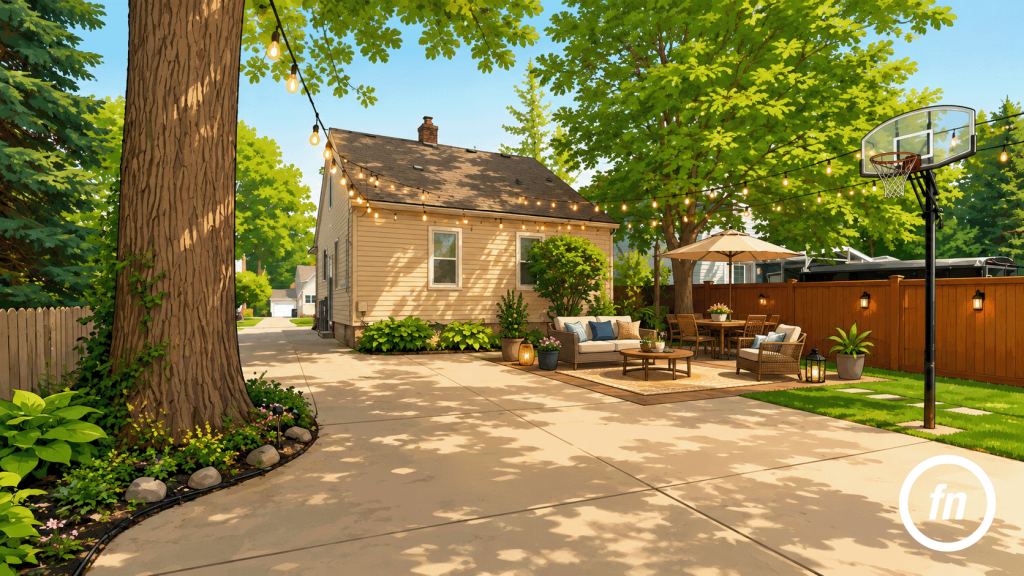
A backyard does not need to be expansive to change the way a house lives. In Royal Oak, where many established neighborhoods are composed of homes on relatively compact lots, the space behind the house often works harder than its dimensions might suggest. A deck becomes the summer dining room. A paved corner beneath a tree becomes a place for morning coffee. A detached garage defines one edge of the yard, while a fence turns what might otherwise feel exposed into something more private and contained.
These are not always the features that command attention in a listing description. Square footage belongs to the house. Bedrooms and bathrooms are counted. Kitchens are photographed from several angles. The backyard may receive only a wide photograph from the rear door and another from the far fence, as though its primary purpose is to document how much grass remains.
Yet a small yard is rarely understood by size alone. What matters is how the space has been organized, how it connects to the house, and whether a buyer can imagine using it.
In a city of established neighborhoods and modest residential lots, that makes the backyard less like leftover land and more like another room—one without a ceiling, perhaps, but with walls, circulation, furniture, and a relationship to everything around it.
For real estate photography, the task is not to make the yard appear larger than it is. It is to make the space legible.
A Small Yard Can Still Have a Floor Plan
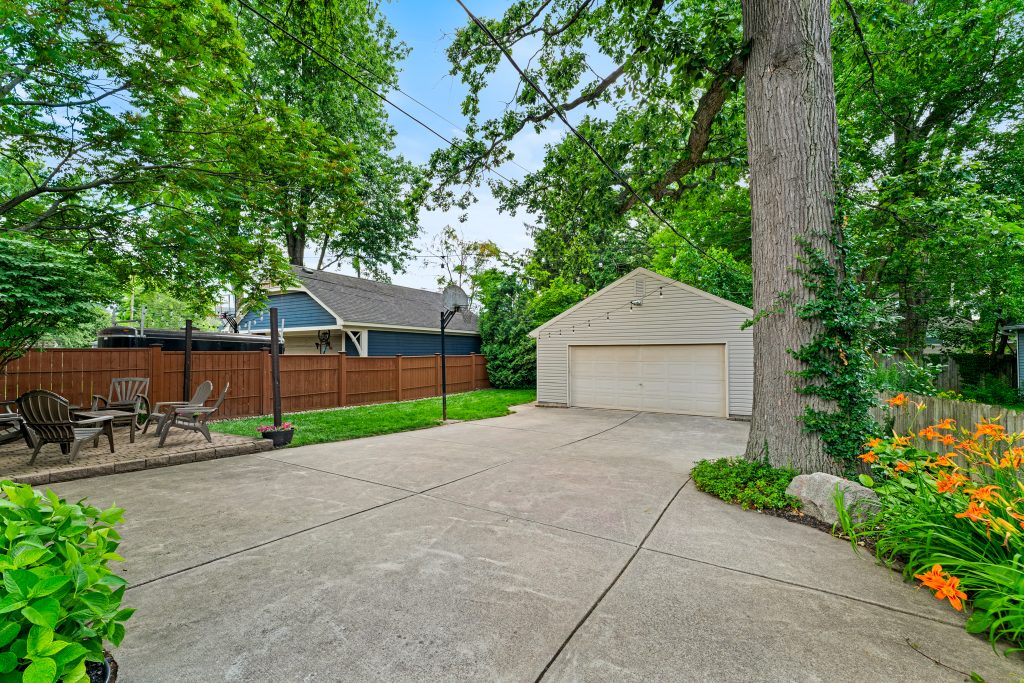
Stand at the back door of a well-used backyard and the space often reveals itself in zones. There may be a deck immediately outside the kitchen, a patch of lawn beyond it, a garage at the rear, and a narrow path connecting one part of the property to another. A fence establishes the perimeter. A tree provides shade. A grill or dining table gives one corner a clear purpose.
None of these elements is especially complicated on its own, but together they create something remarkably similar to an interior floor plan.
The deck becomes a room. The lawn becomes another. The driveway acts as circulation. The fence defines the outer walls, while the garage provides a visual endpoint that can make the entire property feel more organized.
This is particularly important on smaller lots, where every relationship becomes more visible. In a large backyard, a photographer may be able to step back and allow open space to carry the image. On a compact property, the composition has to explain how the pieces fit together.
A photograph from the rear corner of the lot might show the lawn, deck, and rear elevation in a single frame. Another view from the house can reverse the perspective, showing how the yard extends toward the garage. Together, the two images create a spatial conversation: this is what you see when you step outside, and this is how the outdoor space relates back to the home.
The strongest backyard photography does not simply prove that a yard exists. It helps the viewer understand how to move through it.
The Deck or Patio Is Often the Dining Room Extension
The transition between kitchen and backyard can be only a few steps, but in warmer months it can change the way the house functions.
A deck outside a rear door may become the place where dinner moves when the weather is good. A patio can hold the table that would overwhelm a small interior dining area. Even a modest platform with two chairs can create a place to sit outside without asking the lawn itself to do all the work.
This relationship is easy to miss when the deck is photographed as an isolated object.
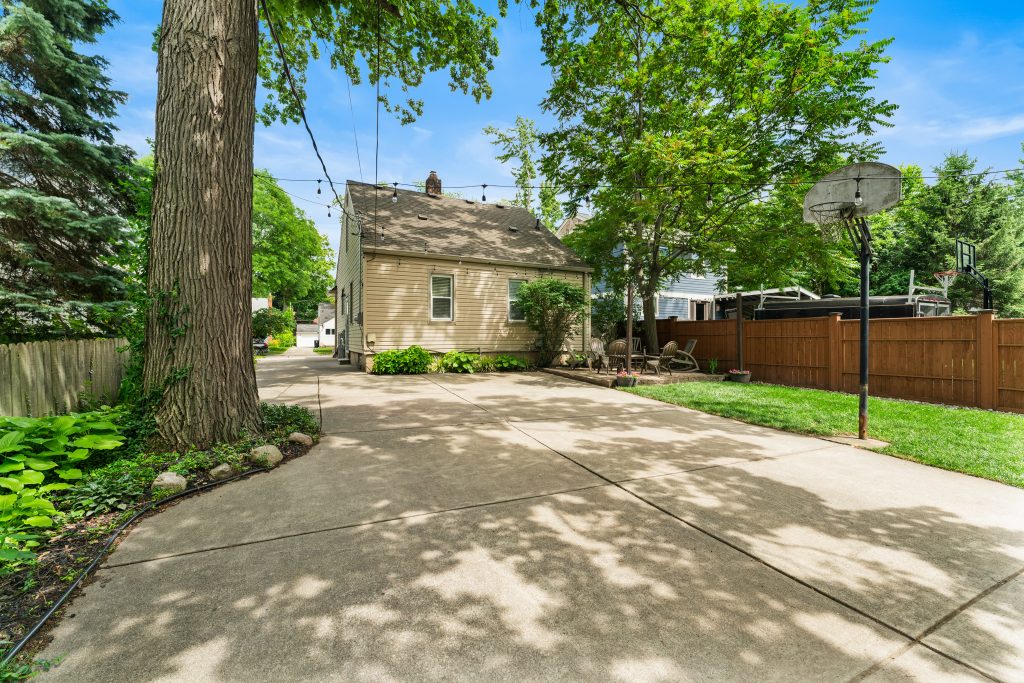
A straight-on image of outdoor furniture may show the seating clearly, but it says little about how that space belongs to the house. A more useful composition often includes the rear door, a portion of the kitchen windows, or enough of the rear elevation to establish the connection between inside and out.
The photograph begins to answer practical questions without feeling instructional. Can someone carry dinner directly from the kitchen to the table? Does the deck sit in afternoon sun or beneath the shade of a mature tree? Is there enough separation from the lawn for the space to feel like a destination rather than a landing?
These relationships are particularly valuable in compact homes. When interior square footage is limited, a well-designed outdoor area can change the experience of the property without changing its footprint. The photography should not imply that a deck is literally additional living area, but it can show how naturally everyday life might extend beyond the back door.
The Best Yard Shot Often Includes the House
There is a familiar way to photograph a backyard: stand near the house and point toward the rear property line. The resulting image may show the lawn, fence, garage, and perhaps a tree or two. It is useful, but it can also leave the viewer looking at a piece of land without understanding its relationship to the home they are considering buying.
Turning the camera around can reveal far more.
From the rear of the lot, the house becomes part of the composition again. The viewer can see the deck or patio against the rear elevation, the doors and windows that connect the interior to the yard, and the relative scale of the outdoor space. A second-floor window, rear addition, or kitchen door suddenly has context.
This is often the photograph that makes a small backyard feel most coherent.
The house provides scale. The lawn creates foreground. The deck or patio becomes the middle ground. Instead of trying to make the yard look endlessly deep, the image shows how the entire property works together.
That honesty can be visually stronger than exaggeration. Buyers know that many established Royal Oak properties do not sit on sprawling suburban lots. What they may not know from a basic listing is whether the available outdoor space feels considered, connected, and usable.
A well-composed rear elevation can answer that question almost immediately.
A Detached Garage Can Organize the Lot
Detached garages are common features of older residential neighborhoods, but in listing photography they are often treated as an obligation: one exterior photograph, usually made with the door closed, placed somewhere near the end of the gallery.
From the perspective of the backyard, however, the garage can be much more important.
Its position helps define the lot. It may terminate a driveway, form one edge of the yard, create a backdrop for a patio, or separate the main outdoor space from an alley or neighboring property. On a compact lot, the garage can give the backyard a sense of enclosure that would otherwise be difficult to achieve.
The relationship is often best shown rather than described.
A photograph that includes the house, yard, and garage can explain the property’s organization in a way that three isolated images cannot. From another angle, the driveway may become visible as the route connecting the street to the rear of the property. If the garage has architectural character of its own—matching brick, original doors, a distinctive roofline—that relationship may deserve additional attention.
The goal is not to make a utilitarian building more important than it is. It is to recognize that the garage occupies real space and often plays a significant role in how the backyard is experienced.
On a small lot, there is very little truly leftover space. Everything participates in the composition.
Privacy Reads Visually
Privacy is another quality that is often described more easily than it is photographed.
A listing may call a backyard private, but the word can mean many things. Perhaps a tall wood fence encloses the property. Perhaps mature shrubs soften the view toward neighboring houses. A garage may block one sightline while a tree canopy creates a sense of shelter overhead. In an established urban or inner-ring suburban neighborhood, privacy rarely means complete isolation.
Photography should be precise about that distinction.
A fence can create a strong visual boundary, especially when photographed from an angle that shows how it wraps the yard. Plantings can soften that boundary and make the space feel less confined. Mature trees may screen upper windows during the growing season, while the same yard becomes more visually open after the leaves fall.
These conditions are part of the property.
The camera does not need to search for an angle that makes neighboring houses disappear entirely if they are plainly visible in person. Instead, the composition can show how the yard creates separation within the reality of the neighborhood.
That approach is both more accurate and, often, more appealing. A compact backyard enclosed by fencing, landscaping, and mature vegetation can feel intimate without pretending to be secluded acreage. The difference lies in showing what creates the sense of enclosure rather than relying on the word private to do all the work.
Fences Are More Than Property Boundaries
A fence may be one of the largest visual surfaces in a small backyard. Its material, height, color, and condition can shape the entire image.
A weathered wood fence can add warmth and texture. A newer privacy fence may create a cleaner, more continuous backdrop. An open fence can preserve sightlines while still defining the lot. In each case, the fence functions almost like an exterior wall, establishing where the outdoor room ends.
That makes composition especially important.
Photographed directly, a tall fence can flatten the yard and make the space feel abruptly enclosed. An angled view allows the boundary to recede, creating depth while still making the lot line understandable. Landscaping along the fence can further soften the transition, particularly when shrubs, ornamental grasses, or garden beds introduce layers between the lawn and the perimeter.
The objective is not to hide the dimensions of the yard. It is to show how those dimensions have been used.
In a well-organized small backyard, boundaries can be an asset. They give the space definition.
The Side Yard Is Part of the Sequence
On compact lots, the side yard is often little more than a passage, yet it can be the connective tissue of the property. It may link the driveway to the backyard, provide access to the garage, or create the route by which guests reach a patio without walking through the house.
This is not always a space that requires its own photograph, but it should influence how the property is documented.
A view from the backyard that includes the side passage can help explain circulation. An aerial image may show the driveway running alongside the house before reaching the detached garage. A floor plan or site-oriented graphic can make the relationship even clearer.
These details matter because buyers are not simply evaluating a collection of attractive spaces. They are trying to understand how the property works.
Where do the trash bins go? How does someone reach the garage? Is there a gate? Can guests enter the backyard from the driveway? Where might bicycles, gardening equipment, or outdoor furniture move through the site?
Not every practical question belongs in the listing copy, but thoughtful media can answer many of them quietly.
Small Backyards Benefit From a Wider Visual Vocabulary
A large yard can often be communicated with one dramatic image. A small yard usually benefits from a sequence.
The first photograph might establish the entire space from the rear of the lot, with the house visible beyond the lawn. A second can reverse the view toward the garage or rear boundary. A closer image might focus on the deck or patio, while another shows the transition through the back door. If the layout is difficult to understand from ground level, an elevated or aerial view can bring the pieces together.
Each photograph should add information.
Repeating nearly identical wide views from three corners of the yard may technically provide coverage, but it does not necessarily improve understanding. A more editorial approach changes distance and perspective deliberately. One image establishes. Another connects. A third reveals a detail.
The result is a visual sequence that feels considered rather than exhaustive.
This is where Royal Oak home photography services can move beyond simple documentation. The value is not in making a small property look artificially large. It is in recognizing which relationships deserve to be shown.
Patio Furniture Can Establish Scale
Outdoor furniture has an unusually useful role in real estate photography because it gives the eye an immediate reference for scale.
An empty concrete patio can be difficult to read in a photograph. Is there room for a dining table? Two chairs? A grill? Without familiar objects, the viewer may have trouble understanding its dimensions.
A modest arrangement can answer those questions almost instantly.
This does not require elaborate staging. In fact, too much furniture can make a small outdoor area feel crowded. A table and four chairs may be enough to establish that the patio functions as a dining area. A pair of lounge chairs can suggest a quieter corner. A bench beneath a tree can make use of a space that might otherwise appear incidental.
The furniture should clarify the space rather than perform for the photograph.
That distinction is important. The backyard does not need to be transformed into an outdoor resort to be appealing. A compact patio can be compelling precisely because its purpose is easy to understand.
Seasonal Context Changes the Room
An outdoor space is never visually fixed.
In summer, a tree canopy may create shade over the deck. In fall, leaves can bring color to the rear elevation and soften the edges of a fence. Early spring may reveal more of the garage, neighboring properties, and lot configuration than the same photograph made in July.
These seasonal changes affect how the backyard reads.
Dense foliage can create privacy but obscure boundaries. Bare branches can make the yard feel more open while revealing its actual organization. Midday summer light may produce deep shade near the house and bright lawn beyond it, while lower evening light can bring warmth to a patio or rear façade.
The photographer has to work with the season that exists, not the one that would be ideal.
That may mean choosing an angle that takes advantage of summer shade rather than trying to eliminate it. In colder months, it may mean paying closer attention to structure—the fence lines, garage, hardscape, and relationship between the house and lot—when greenery is no longer carrying the composition.
A good backyard photograph does not need perfect weather or peak landscaping. It needs a clear understanding of what the space is offering at that moment.
Drone Photography Can Clarify What the Ground Cannot
Aerial photography is particularly useful on compact residential lots because it can reveal relationships that are difficult to understand from eye level.
From above, the property becomes a composition of connected pieces: house, driveway, deck, lawn, garage, and surrounding lots. The viewer can see where the outdoor space sits relative to the home and how the detached garage organizes the rear of the property.
The challenge is altitude.
Fly too high and the individual property becomes a small shape among many. Fly too low or at the wrong angle and trees may obscure the very layout the image is intended to explain. The most useful aerial view is often oblique rather than perfectly vertical, high enough to reveal the lot but low enough that the house remains recognizable.
As with every other backyard image, the objective is clarity rather than spectacle.
A dramatic aerial photograph can be beautiful. A useful one should also help the buyer understand something.
The Backyard Should Feel Connected to the House
The most successful small backyards tend to have a sense of continuity with the home. That connection may be physical—a door opening directly from the kitchen onto a deck—or visual, with interior windows overlooking the lawn and garage beyond.
Photography can reinforce that relationship by allowing the two spaces to appear together.
From inside, a composition may include the rear door or windows with a glimpse of the deck beyond. Outside, the reverse view can show those same openings in the rear elevation. The buyer begins to understand the backyard not as a separate feature at the end of the listing, but as part of the daily experience of the house.
This is especially valuable in smaller homes, where outdoor space can complement the interior without needing to imitate it. The backyard does not become another room because someone places a sofa outside. It becomes room-like because it has boundaries, purpose, circulation, and a clear relationship to the spaces beside it.
The Small Backyard Has Become a Selling Room
A modest lot asks for a different kind of attention.
There may be less open land to photograph, but there are often more relationships to explain. The deck meets the house. The driveway leads to the garage. The fence defines the perimeter. The lawn connects one part of the property to another. Trees and landscaping create shade, privacy, and seasonal change.
When these elements are photographed separately, the backyard can feel like a collection of features. When they are photographed in relation to one another, the space begins to make sense.
That is the opportunity in a Royal Oak backyard. It does not need to compete with an acre of lawn or an elaborate outdoor kitchen. A small patio can still become the place where dinner moves in July. A detached garage can give the lot structure. A fence can turn a compact patch of grass into a more intimate outdoor setting.
The best listing photography does not ask the yard to appear larger than it is. It shows how much life can fit within the space that is already there.
Because sometimes the most important room in the house is the one just outside the back door.
